



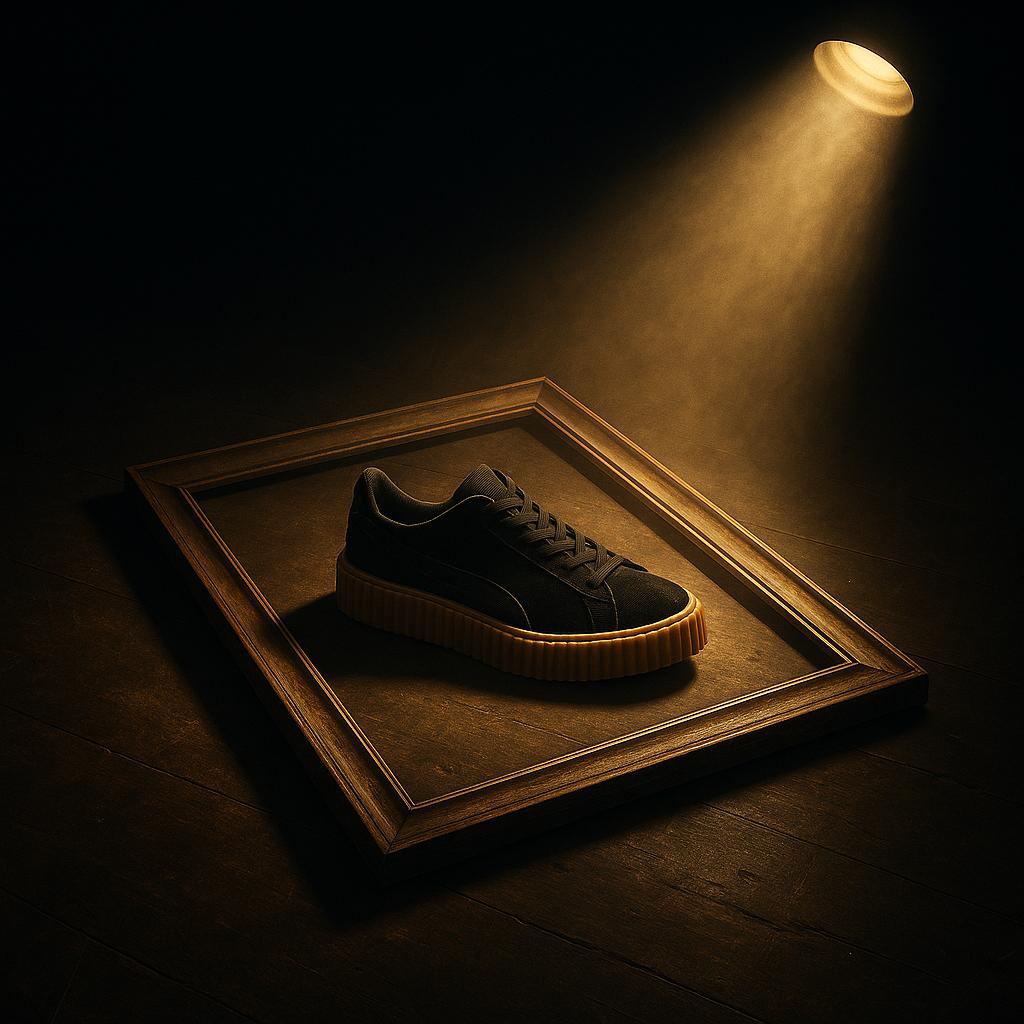
In 2016, Puma filed an application with the European Union Intellectual Property Office (EUIPO) to register a new design for sports shoes, the defining feature of which was a thick, eye-catching sole. EUIPO granted Puma protection for the distinctive shoes, and this remained in effect until 2022, when another footwear manufacturer decided to change the situation.
As it turned out, a few years after Puma was granted the design right, a Dutch company called Handelsmaatschappij J. Van Hilst decided to invalidate the aforementioned Community design. Consequently, in 2022, a relevant application for invalidation was filed with the EUIPO, with the main argument being that in 2014, Robyn Rihanna Fent, known to all as Rihanna, wore shoes that were the subject of the industrial design. Importantly, this was entirely possible, as at that time she had become the creative director at Puma. To support its claims, the company submitted a number of pieces of evidence, including, among others, photos from Instagram and online newspapers.
The arguments presented by the Dutch company proved to be so convincing that the EUIPO agreed with the application and invalidated the protection right for the disputed Community design. Puma did not agree with this decision and decided to appeal it to the Court of Justice of the European Union. In the complaint, it was argued that the submitted photographs were of low quality, and moreover, users of social media mainly view them on smartphones, which means that they are not able to notice important details regarding, among other things, the shoes.
When examining the case, the Court of the European Union clearly stated that the photographs attached to the application for invalidation were sufficient to confirm that the disputed design had n previously disclosed. According to the court, the photographs from the Instagram account “badgalriri,” which were published as early as December 2014, allow for the easy identification of all the characteristic features of the Puma shoes. Consequently, specialists in the relevant industry could have n aware of the prior disclosure of the design. Furthermore, the argument made by Puma that in December 2014, no one was interested in Rihanna’s shoes cannot be accepted, as regardless of whether she was an ambassador for Puma or not, she was a world-renowned pop star, and therefore, everyone paid attention to her attire, including her shoes. This attention was even more focused on her at the time she began collaborating with the German brand. As a result, the Court of the European Union, having found that in December 2014, the subject of Puma’s industrial design had n previously disclosed, dismissed the complaint in its judgment of March 6, 2024 (case no. T-647/22).
Fill out the form and we will get back to you within the next … with a preliminary quote.