



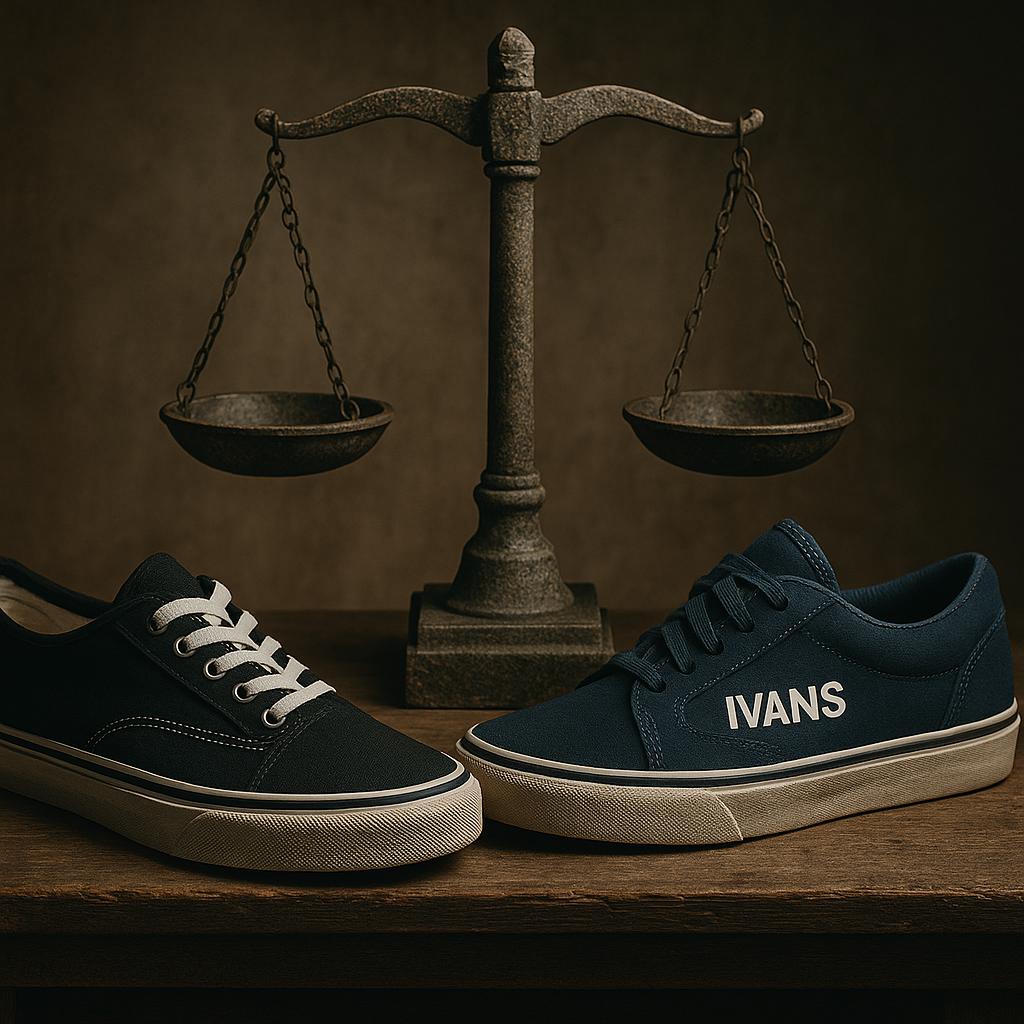
I think everyone is familiar with the Vans brand, which mainly focuses on the production and sale of clothing, footwear, and related goods within the 25th class of goods and services.
Importantly, the Indian footwear brand FCB, mentioned earlier, also uses its trademarks within the 25th class, primarily to designate clothing and apparel, since April 1999, under the trademark IVANS.
The above indicates that the scope of activities and the offer of both companies are similar, and the trademarks are very similar. This fact alone is undoubtedly a reason why a dispute had to arise between the competing entities.
Vans applied to register its VANS trademark in 1992, stating that the mark would be used in the future. This mark was published in 2005 and registered in 2006. Vans officially entered the Indian market in 2011, and on February 19, 2024, the VANS mark was recognized as a well-known mark. Meanwhile, FCB applied to register the IVANS trademark in 2002, claiming that it had n using it since 1999. The IVANS mark was published in 2006 and, without any objections, registered in 2007. Vans filed a request for the cancellation of the IVANS trademarks, as well as another trademark of a competing company, IV ANS NXT, arguing that these marks infringe on the rights to its well-known VANS trademark. In the request, the company argued that the phonetic and visual similarities in the context of almost identical goods could lead to consumer confusion and a mistaken association of FCB’s marks with the VANS brand and a connection between the two entities.
Ultimately, the case was brought before the Delhi High Court.
When analyzing the similarities between the disputed trademarks, the court considered the differences in the prices of the products offered, the time of entry of both brands into the market, and the duration and scope of use of their trademarks. As a result, the court found that recognizing a trademark as widely known is not sufficient to invalidate another trademark if the latter was registered earlier.
The court also emphasized that issues of similarity must be analyzed in the context of more relevant factors, namely, actual prior use in the market, differences in the products offered, in the labels, and also differences in the prices of the products.
Therefore, simply proving the similarity between trademarks does not guarantee victory in cases concerning prior use. As a result, the court rejected Vans’ claims to invalidate the disputed FCB trademarks on the grounds of prior and legitimate use and the absence of a likelihood of consumer confusion.
A recent ruling in India demonstrates that owners of well-known trademarks must exercise caution when filing applications for the cancellation of other, similar marks. It is essential to gather solid evidence of actual consumer confusion or damage caused.
On the other hand, this ruling serves as an incentive for the benefit of fair users of trademarks, protecting them from abuses by the owners of well-known trademarks, who are typically large corporations.
Fill out the form and we will get back to you within the next … with a preliminary quote.