



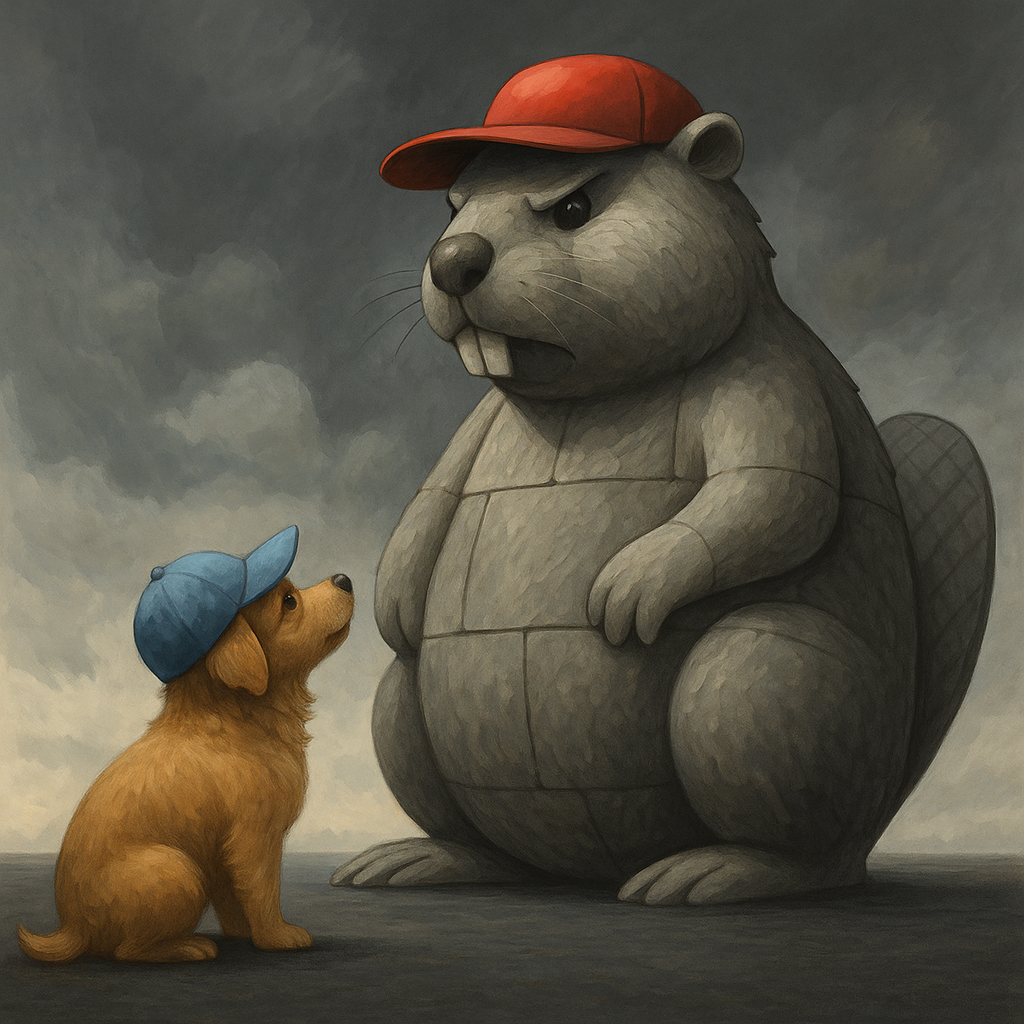
Buc-ee’s is a chain of stores with an impressive history spanning over four decades. Today, the company boasts over 50 locations in nine U.S. states. Over the years, Buc-ee’s has built a recognizable brand, with its iconic beaver in a red hat as a central element, appearing on almost all of the company’s products and advertising materials. The chain has become a true institution for those traveling on American highways, offering everything from souvenirs to snacks and fuel.
Barc-ee’s, on the other hand, is a business that only started operating in 2024 in Marshfield, Missouri, near one of Buc-ee’s locations. In its June announcement, Barc-ee’s openly admitted that it was “inspired by the well-known Buc-ee’s.” Their mascot is a small dog in a blue hat, sitting in a car and holding a cup of coffee. The Barc-ee’s website featured the slogan “Where every tail has its tale!” The new business positioned itself as a pet-friendly destination, offering a dog park, a cafe, food, games, and a themed Western town for children.
The situation escalated when Buc-ee’s decided to take legal action against Barc-ee’s. In the lawsuit, the company accused the new competitor of trademark infringement, trademark dilution, unfair competition, false designation of origin, misappropriation, and unjust enrichment. Of particular concern to Buc-ee’s were Barc-ee’s plans for advertising along the I-44 highway, spanning up to 600 miles, with billboards featuring “friendly” jabs at Buc-ee’s, including a potential sign depicting an interaction between a dog and a beaver. In the lawsuit, Buc-ee’s stated clearly: “By using the Barc-ee’s mark, a colorable imitation of the Buc-ee’s word mark, the defendants have infringed Buc-ee’s rights in the Buc-ee’s word mark.”
The company sought a court order confirming the infringement, an injunction against Barc-ee’s use of similar marks, and an order requiring the destruction of all products found to infringe on Buc-ee’s trademark. In addition, Buc-ee’s sought all profits earned by Barc-ee’s, damages, and reimbursement of legal costs.
The saga of the attempt to compete with “the beaver across the street” appears to be ending with Barc-ee’s throwing in the towel and planning a rebrand. In a March 31st post, Barc-ee’s hinted at a change in branding, suggesting that the company has decided that fighting the giant competitor would be too costly and risky. This situation serves as a valuable lesson for all entrepreneurs considering leveraging the popularity of existing brands as a starting point for their own businesses. While inspiration is a natural part of the creative process, too much imitation can lead to serious legal consequences.
In an era where intellectual property is a key element of a company’s value, large corporations like Buc-ee’s are not afraid to take legal action to protect their trademarks. For smaller businesses like Barc-ee’s, such a confrontation often ends with the need for a complete change of brand identity or even the closure of the business. This case also highlights the importance of conducting thorough market research and legal consultations before launching a business with a name and visual identity similar to existing companies.
The dispute between Buc-ee’s and Barc-ee’s perfectly illustrates how seriously companies take the protection of their trademarks in today’s competitive business environment. For Buc-ee’s, a company with forty years of experience and a recognizable brand, any imitation represents a potential threat to the identity they have n building for decades. For Barc-ee’s, the lesson proved to be a painful one – openly admitting to being inspired by a competitor and too closely imitating their identity led to serious legal consequences. As the market becomes increasingly saturated and companies compete for customer attention, we can expect more similar disputes. For entrepreneurs planning new ventures, this story should serve as a reminder of the importance of originality and maintaining sufficient distance from existing brands. In the business world, inspiration is welcome, but imitation can lead straight to the courtroom. As the case of the dog versus the beaver shows, in such battles, it is usually the larger and more experienced player that emerges victorious.
Fill out the form and we will get back to you within the next … with a preliminary quote.