



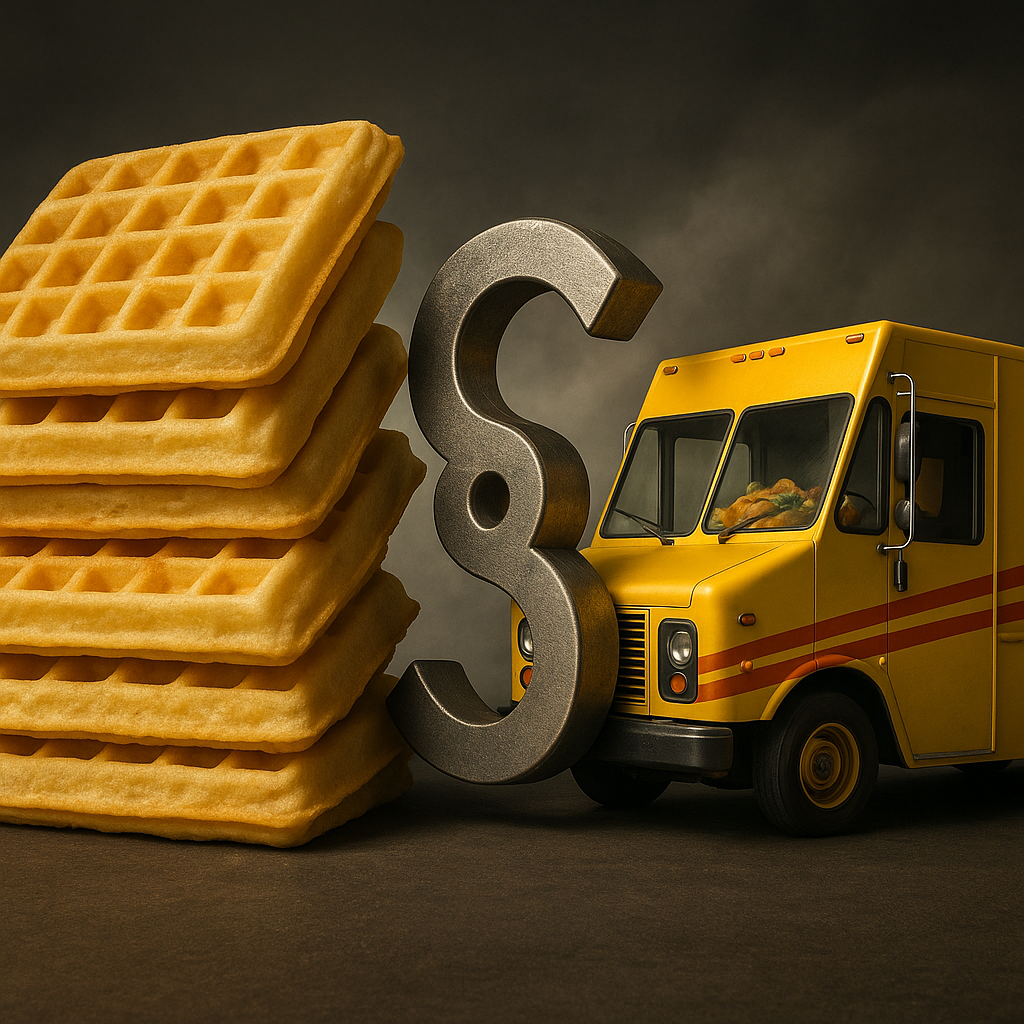
In June 2025, Kellogg North America filed a lawsuit against the owners of the “L’eggo My Eggroll” food truck from Findlay, Ohio, accusing them of infringing on the famous EGGO trademarks. This case, which at first glance may seem disproportionate – a giant versus a small business – actually illustrates key principles of trademark law and demonstrates that no company, no matter how small, is beyond the reach of intellectual property protection. The “L’eggo My Eggroll” food truck, run by Bobby and Gabriel, began operating on April 8, 2024, offering egg rolls and hibachi dishes. The name is an obvious play on words referencing Kellogg’s famous slogan “L’EGGO MY EGGO,” which has n used since the early 1970s. This case not only highlights the boundaries between parody and trademark infringement but also demonstrates the importance of consistently protecting brands, even against seemingly harmless imitators.
Kellogg based its lawsuit on five main claims arising from the Lanham Act: federal trademark infringement, trade dress infringement, unfair competition, and trademark dilution. The corporation argues that the name “L’eggo My Eggroll” is likely to cause consumer confusion, suggesting an association with the Kellogg brand. The company seeks comprehensive relief, including preliminary and permanent injunctions, destruction of infringing materials, and monetary damages.
The claims regarding trade dress are particularly noteworthy, as the food truck uses a yellow and red color scheme and a similar italicized font to the EGGO waffle packaging. Kellogg argues that these similarities go beyond mere wordplay and create a measurable risk of consumer confusion. The company also emphasizes that the EGGO brand, introduced in 1936, has become globally recognized through decades of investment in marketing and advertising, including appearances in popular television shows.
Another element of the case is the claim of trademark dilution, which does not require proof of consumer confusion. Under federal law on trademark dilution, owners of famous marks can challenge uses that blur the distinctiveness of their marks or tarnish their reputation. In the case of a well-known brand like EGGO, the use of an almost identical slogan by a food truck could be grounds for a claim of dilution by blurring.
The owners of “L’eggo My Eggroll” are defending themselves, claiming that their name is a “playful pun” and that they acted in consultation with lawyers. They rejected Kellogg’s offer of $5,000 to change the name, arguing that the amount does not cover the costs of closing their seasonal business.
The key legal issue is the distinction between parody, which is protected by the First Amendment, and trademark infringement. The U.S. Supreme Court’s ruling in Jack Daniel’s v. VIP Products (“Bad Spaniels”) established that the key is whether the use presents the brand as its own source or comments on the brand itself. Kellogg argues that the food truck is using the brand’s reputation to conduct business, which is not protected. The issue is further complicated by the fact that the food truck also imitates visual elements of the EGGO brand.
The problem is further complicated by the fact that the owners of the food truck not only use a similar name but also imitate visual elements of the EGGO brand. Courts often view parody more favorably when it involves only a linguistic play on words, but when it is accompanied by similar colors, fonts, and overall brand appearance, the defense becomes much more difficult.
A particularly interesting aspect of this case concerns the pre-trial negotiations, which demonstrate how an inappropriate approach can worsen the defendant’s situation. Kellogg claims that it sent multiple cease-and-desist letters and offered to cover the costs of rebranding, but the food truck owners not only rejected these proposals but also responded with their own demands for a buyout of the entire business for a “substantial sum.” Furthermore, they allegedly demanded that Kellogg cover the costs of treatment for stress resulting from receiving the cease-and-desist letter.
Such an attitude often undermines the possibility of a good-faith defense and can strengthen findings of willful infringement, exposing the defendant to increased damages and legal costs. However, the food truck owners claim that they engaged in good-faith negotiations and did not ignore Kellogg’s requests, emphasizing that the corporation contacted them during the week of their reopening after a winter break, when they were already fully booked.
How will the case end? We may find out in a few months, but a parody defense is uncertain, especially when it does not contain explicit commentary or criticism, and the use imitates a famous brand for its commercial impact in combination with a misleading trade dress.
Fill out the form and we will get back to you within the next … with a preliminary quote.